
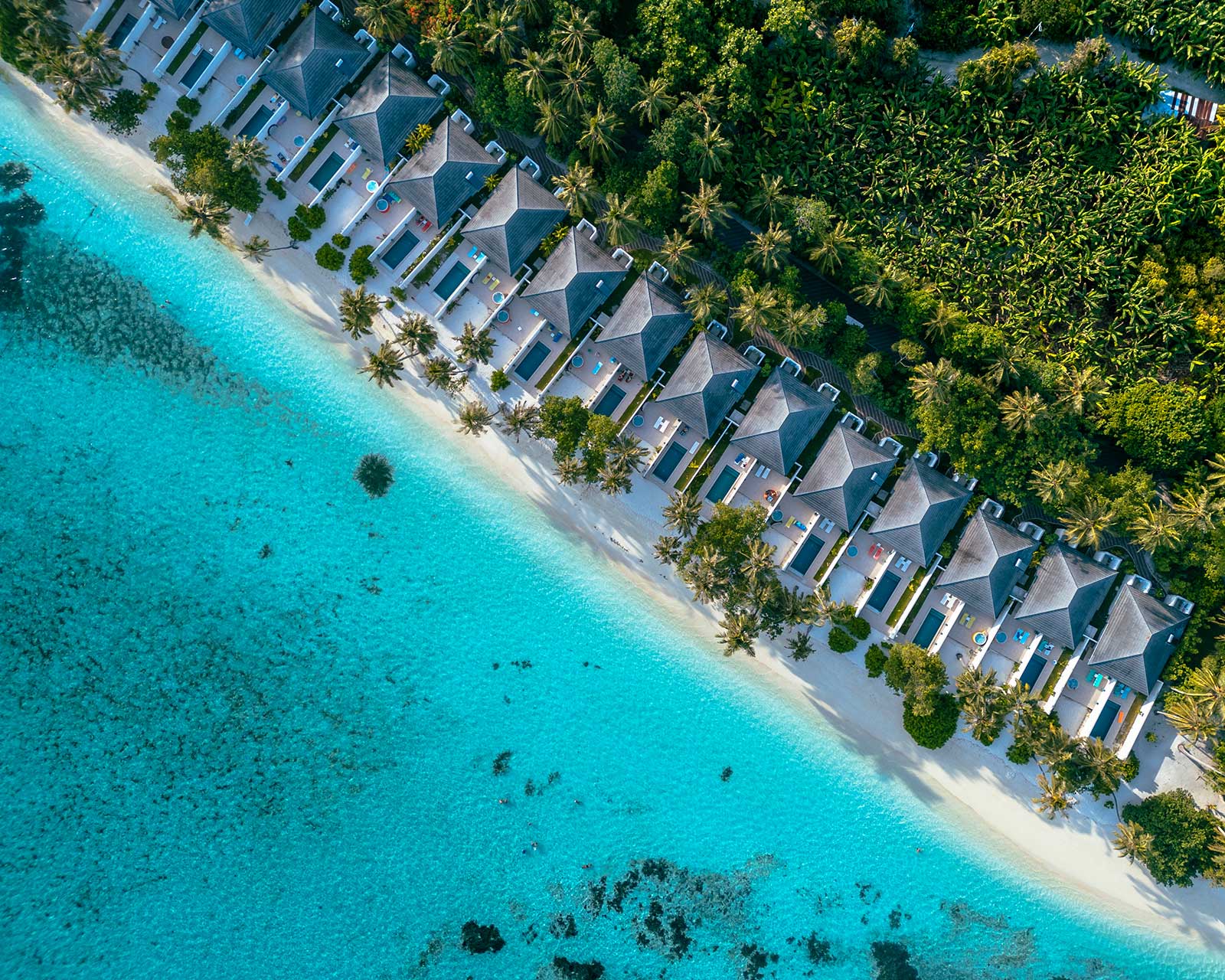
Where to stay
Resorts, guesthouses, liveaboards and yachts — and how to choose between a beach and an overwater villa.
Where To Stay
Private Island Resorts
A resort island is usually dedicated to a single property. Accommodation, restaurants, bars, spa, watersports, diving, excursions and entertainment are all on the same island.
This is the standard private-island resort model in the Maldives, ranging from lower-priced beach resorts to high-end private-island properties.
Best of Maldives – browse resorts
Local Island Guesthouses
Guesthouses and hotels on inhabited islands let you experience everyday Maldivian community life while still enjoying beaches, diving, snorkelling and excursions, usually at a far lower cost than a resort.
Local island stays follow local customs:
- Alcohol is not available.
- Modest dress is expected in public areas.
- Swimwear such as bikinis should be worn only on designated tourist ("bikini") beaches.
Guesthouses usually carry the lower USD 6 Green Tax rate.
City Hotels In Malé And Hulhumalé
Hotels in Malé and Hulhumalé suit short stopovers, late arrivals, early departures and travellers who want to explore the capital. Hulhumalé is minutes from the airport and has a public beach, cafés and restaurants.
Homestays
Homestays are a newer option that lets you stay with a Maldivian family on an inhabited island, for a close-up experience of local culture, food and daily life. Local-island customs apply, as for guesthouses.
Airbnb-style rentals, hostels and couchsurfing are far less common in the Maldives than in many destinations. Book guesthouses and homestays before you arrive, as walk-in availability on local islands can be limited.
Liveaboards
Liveaboards are suited to travellers focused on diving, surfing or visiting several atolls in one trip. Guests stay aboard a vessel, with accommodation, meals and organised activities included. Many diving liveaboards follow set routes planned around seasonal marine life.
Alcohol may be served on licensed tourist vessels. Liveaboards carry the USD 12 Green Tax rate.
Private Yachts And Marinas
Private yacht charters let guests set their own route between islands, sandbanks, dive and fishing spots, with crew and chef on board. The Maldives also has yacht marinas for visiting superyachts and sailing vessels. Foreign yachts need a cruising permit and a local agent.
Multi-Island Holidays
Common combinations include:
- Two resorts in different atolls.
- A local island followed by a resort.
- Two local islands.
- A liveaboard followed by a resort.
- A night in Malé or Hulhumalé combined with an island stay.
Plan transfer logistics before booking, and avoid non-refundable bookings until the connection is confirmed.
To stretch a budget, start with a mid-range resort or a local island, then finish at a more luxurious property. You end the holiday on a high, and the average nightly cost comes down. Remember that each move adds transfer costs and time.
Can You Eat Or Drink At Another Resort?
Usually not. Most resorts sit alone on their own island, so visiting another resort for dinner is rarely practical. There are some exceptions:
- Multi-resort destinations, where several hotels share a lagoon, marina or island cluster, such as Fari Islands (North Malé) and Crossroads Maldives (South Malé). These often let guests dine at neighbouring venues.
- Sister resorts close to each other, which may offer "dine-around" programmes.
- Paid excursions: some resorts sell visits to nearby islands or partner venues.
If variety matters, choose a resort with several restaurants, or one of these destinations, and ask what is included before booking.
How To Choose A Maldives Resort
Location And Transfer
Start with how you will get there. A short speedboat transfer suits a brief holiday and late arrivals. A seaplane or domestic flight opens up more remote atolls, but adds cost and time and depends on your arrival time.
Island Size
Small islands feel intimate and are easy to walk around. Larger islands usually offer more restaurants, longer beaches and more activities, and may use bicycles or buggies to get around.
Beach And Lagoon
Beaches and lagoons differ from island to island. Some islands have wide, shallow lagoons that are suitable for young children, paddling and watersports. Others have deeper water and reefs close to shore, which may suit snorkellers.
Beaches can also change with the seasons, as sand shifts with the monsoons.
House Reef
A house reef is a reef you can reach directly from the island, or close to it.
For keen snorkellers, the quality and accessibility of the house reef can be the deciding factor. Check:
- How far the reef edge is from the beach or villas.
- Whether there are marked entry and exit points.
- Whether current conditions change with the tides and seasons.
Best house reef resorts – Best of Maldives category
Dining
Consider:
- The number of restaurants and bars.
- The variety of cuisine.
- Buffet and à la carte options.
- Support for dietary requirements.
- Private and destination dining.
- What your meal plan includes, and which venues it covers.
Villa Choice
Common options include:
- Beach rooms and beach villas.
- Pool villas.
- Overwater villas.
- Lagoon villas.
- Family villas.
- Two-bedroom or multi-bedroom residences.
The most photographed villa is not always the best choice.
Beach Villa Or Overwater Villa?
Overwater villa
+ A widely associated Maldives accommodation style, commonly chosen for honeymoons and celebrations.
+ Direct lagoon access from the deck, which can be convenient for swimmers and snorkellers.
+ Uninterrupted ocean views.
– Often smaller than an equivalent beach villa.
– The villa usually faces either sunrise or sunset, so choose which matters more to you.
– Can be a long walk or buggy ride along the jetty to restaurants and the beach.
– Less suited to small children; some resorts set minimum ages, and open decks and ladders need supervision.
– Typically more expensive.
Beach villa
+ Often more spacious and more private, screened by tropical vegetation.
+ Direct access to your own stretch of sand.
+ Usually closer to the island's restaurants and facilities.
+ Safer and easier for families with young children.
+ Often better value.
– Less of the overwater "wow" factor.
– Snorkelling may be a swim away rather than right below the deck.
Consider a split stay: a few nights in each type lets you experience both. Some resorts discount room moves within the same property.
Beach villa vs overwater villa guide / Browse overwater villas / Browse beach villas
Meal Plans
Bed & Breakfast
Breakfast only; other meals are paid separately.
Half Board
Breakfast and one other meal, usually dinner.
Full Board
Breakfast, lunch and dinner. Drinks are usually extra.
All-Inclusive
Meals plus selected drinks, and sometimes activities. What is included varies greatly between resorts. Some offer several tiers, such as "all-inclusive", "premium" and "platinum". Check:
- Which restaurants are included.
- Which drinks are included, and whether branded spirits and wine are covered.
- Whether minibar, excursions or spa credits are included.
- Whether transfers are included.
Always read the exact inclusions rather than assuming every all-inclusive package is the same.
Kids Club And Family Facilities
Families may want to compare:
- Kids club age ranges and opening hours.
- Babysitting availability and cost.
- Family villas and interconnecting rooms.
- Children's menus and meal plan pricing for children.
- Shallow, calm swimming areas.
- Pool fencing and villa safety features.
- Family excursions and teen activities.
Spa And Wellness
Wellness-focused travellers can compare spa facilities, yoga, fitness programmes, nutrition, meditation, visiting practitioners and structured retreats.
Diving And Watersports
For an active holiday, check whether the resort has:
- A PADI, SSI or other recognised dive centre.
- House reef diving, and the range of nearby dive sites.
- Nitrox and courses for all levels.
- Surf access and surf boat transfers.
- Motorised watersports.
- Non-motorised watersports.
- Freediving instruction.
- Guided snorkelling and marine biology programmes.
Entry rules, taxes and transport operations can change. Sections marked with an update stamp contain time-sensitive information. Always confirm current requirements with official sources before departure.Guide last reviewed: September 2026